
Why Learning Through Play Works for Every Child
Charley
3/19/20263 min read
What is Learning Through Play?
If you have ever watched your child build a fort out of couch cushions or turn a spoon into a microphone, you have already witnessed one of the most powerful forms of learning.
It may look like fun. It is actually serious brain work.
When children play, they build problem-solving skills, regulate emotions, test ideas, and connect new concepts. At Little Sprouts Learning Hub, I believe play is not a break from learning. It is the method of learning. Learning through play is important because it helps children develop cognitive, social, emotional, and physical skills in a natural and engaging way.
Here is why it works and how you can make it part of everyday life without adding stress
🧠 The Science Behind Play
Research consistently shows that children learn best through joyful, meaningful engagement.
The LEGO Foundation highlights that effective play is joyful, actively engaging, meaningful, iterative, and socially interactive. Those giggles and repeated attempts are signs of deep learning.
The National Association for the Education of Young Children explains that playful learning supports initiative, creativity, independence, and confidence long before formal schooling begins.
Research from the U.S. Department of Education’s Institute of Education Sciences shows that play-based learning strengthens cognitive, language, social, and emotional development more effectively than rigid, drill-based instruction alone.
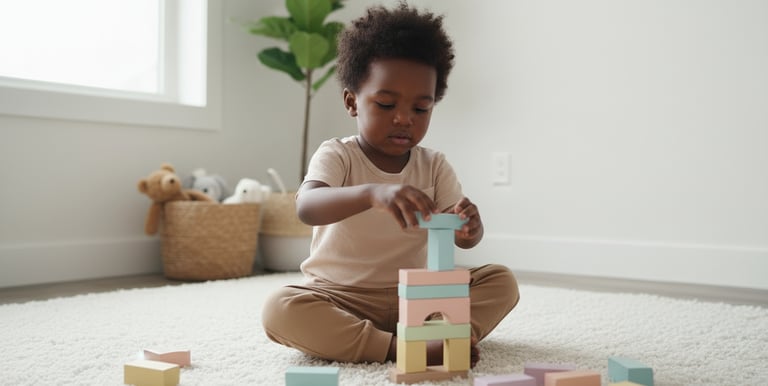
Translation? When your child stacks blocks, pretends to cook, or builds a blanket castle, their brain is actively wiring connections.
🧩 What Is Really Happening During Play
When children engage in open-ended play, they are:
Exploring cause and effect
Building memory and attention
Expanding vocabulary
Sorting, comparing, and estimating
Practicing turn-taking and empathy
Learning emotional regulation
Even pretend play builds mastery and confidence. Children test ideas, make mistakes, adjust, and try again. That process strengthens resilience.
🌱 How Parents Can Nurture Learning Through Play
You do not need special training. You need presence.
Here are simple ways to bring purpose into play:
Follow their lead. Let your child guide the story or activity.
Ask open-ended questions such as, “What do you think will happen next?”
Add gentle challenges. Introduce new materials or small problems to solve.
Connect play to real life. Sorting laundry, counting apples, or building with pillows all count.
The goal is not to make play productive. The goal is to keep it curious and connected.
🌈 Inclusive Play Adaptations
Play works for every child because it can be flexible.
For children on the autism spectrum, with sensory sensitivities, or who benefit from added structure, try:
Offering clear boundaries for play spaces
Limiting materials to reduce overwhelm
Using visual supports or simple step-by-step modeling
Allowing extra processing time
Pairing movement with learning tasks
Some children regulate through motion. Jumping before building. Marching while counting. Crawling under the “fort” before adding pieces.
Strong regulation supports deeper engagement.
The learning goal stays the same. The pathway simply adapts
🏡 A Quick-Start Game for Home
Try this simple activity:
Treasure Hunt With a Twist
Hide five small objects around a room.
Ask your child to find something soft, blue, or that rolls.
Once found, talk about its color, shape, and function.
You have just combined language, categorization, movement, and observation in one short activity.
💬 A Word
As both a mom and an early educator, I have seen the difference play makes. When children are allowed to explore freely and safely, curiosity grows. Confidence follows.
You do not need expensive toys or elaborate plans. You need time, attention, and space for imagination.
At Little Sprouts Learning Hub, my goal is to help you recognize that the everyday moments already hold powerful learning opportunities.
Every tower stacked. Every question asked. Every pretend story told.
They matter.
Let’s grow curious minds together, one playful moment at a time.
📚 Research Spotlight
LEGO Foundation (2024). The Scientific Case for Learning Through Play.
National Association for the Education of Young Children (2023). The Power of Playful Learning.
U.S. Department of Education, Institute of Education Sciences (2023). Play-Based Learning and Early Childhood Development.
Harvard University, Center on the Developing Child (2023). Play, Executive Function, and Brain Development.
López-Nieto et al. (2022). Play-Based Interventions Supporting Development in Children with Autism Spectrum Disorder. Structured caregiver-guided play supports communication, engagement, and developmental growth.